Infertility can feel like an unexpected roadblock on the journey to parenthood. Thankfully, modern fertility treatments have transformed the possibilities for couples and individuals who dream of having a child. One of the most significant advances in reproductive medicine is egg freezing and IVF using frozen eggs.
But a common question remains: How successful is IVF with frozen eggs?
The good news is that advancements in freezing techniques have dramatically improved success rates over the past decade. Today, many women who freeze their eggs at a younger age have an excellent chance of achieving pregnancy later through IVF.
Think of frozen eggs like seeds stored carefully in a vault. If preserved properly and planted under the right conditions, they can still grow into healthy plants years later. Similarly, frozen eggs can retain their reproductive potential and help create healthy pregnancies long after they are frozen.
In this article, we’ll explore IVF success rates with frozen eggs, the factors that influence outcomes, and how choosing the best IVF Doctor in Delhi NCR can make a significant difference in your fertility journey
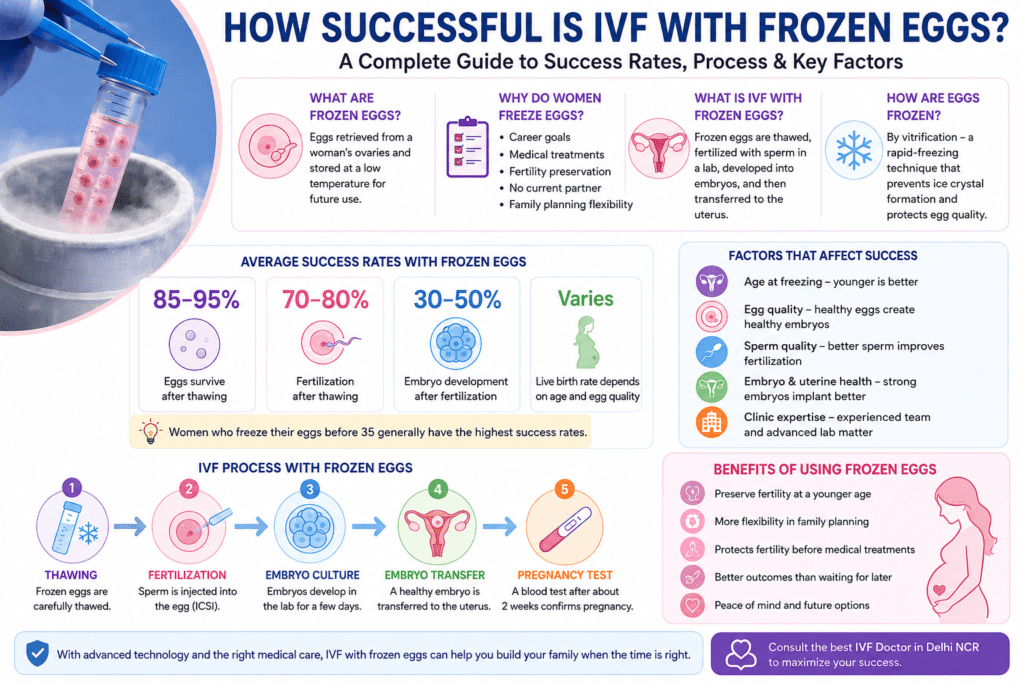
Table of Contents
| Sr# | Headings |
|---|---|
| 1 | What Are Frozen Eggs? |
| 2 | Understanding IVF with Frozen Eggs |
| 3 | How Are Eggs Frozen? |
| 4 | Success Rates of IVF with Frozen Eggs |
| 5 | Does Age at Egg Freezing Matter? |
| 6 | Factors That Affect IVF Success |
| 7 | Frozen Eggs vs Fresh Eggs |
| 8 | Benefits of Using Frozen Eggs |
| 9 | Challenges and Limitations |
| 10 | What Happens During the IVF Process? |
| 11 | How Many Frozen Eggs Are Needed? |
| 12 | Improving IVF Success with Frozen Eggs |
| 13 | Choosing the Best IVF Doctor in Delhi NCR |
| 14 | Emotional and Financial Considerations |
| 15 | Future of Egg Freezing and IVF |
What Are Frozen Eggs?
Frozen eggs are eggs retrieved from a woman’s ovaries and stored at a low temperature for future use. Women choose to freeze their eggs for several different reasons like:
- Delaying a pregnancy for career goals
- Beginning a potentially fertility harming medical treatment like chemotherapy
- Preserving fertility for future use
- Not currently having a partner
- Flexibility in family planning
Eggs are not used until a woman is ready to undergo the IVF process.
Understanding IVF with Frozen Eggs
IVF, In Vitro Fertilization, is the process of creating a baby outside of the body by fertilizing an egg with sperm in a lab.
When frozen eggs are used in IVF that process involves:
- Thawing frozen eggs
- Thawing frozen eggs
- Preparing the now fertilized egg by allowing it to develop in the lab
- Transferring the now developed embryo to the uterus
If the embryo successfully implants a pregnancy will occur.
Using frozen eggs during IVF is seen as safe and effective, and many times the outcome of the frozen egg and sperm transfer is equal to that of a fresh egg transfer.
How Are Eggs Frozen?
The process of choice for freezing eggs is called vitrification.
What Is Vitrification?
When vitrification is done it rapidly lowers the temperature and freezes the egg while avoiding the process of creating ice crystals in the egg. Before vitrification became a technique that was quick and easy to freeze eggs, traditional freezing and slow cooling methods would sometimes damage the egg. The slow methods of cooling and freezing would sometimes create a situation where the egg would form ice crystals. This technique of vitrification is now important for the preservation of fertility because it yields:
- High rates of egg thawing success
- Higher rates of embryo development after egg thawing
- Higher rates of pregnancy post embryo transfer
- Less damage to the egg on a cellular level
Because of vitrification technology many fertility clinics report that after egg thawing over 90% of the frozen eggs survive.
4. Frozen Eggs and IVF Success %
Many things can impact the success of IVF and frozen eggs, but positively successful outcomes are likely.
What Are Some Average Success %
- Eggs can be frozen and survive thawing: 85-95%
- Fertilization after thawing: 70-80%
- Embryo development after fertilization: 30-50%
- Live birth rate also varies depending on age and egg quality.
Women who are 35 and under when they freeze their eggs generally have the most successful outcomes.
What Is The Meaning Of This?
If a woman is able to freeze a healthy amount of eggs when she is younger, her outcome of future successful pregnancies is likely to occur.
Do keep in mind that success should be determined by healthy live births and not just fertilization.
5. How Important Is The Age When An Egg Is Frozen?
Age is the most important factor when it comes to successful IVF of frozen eggs.
Why Age Is Important
Cumulatively, as a woman gets older, the quality of her eggs declines, there is an increase in chromosomal abnormalities, and her fertility begins to decline.
What Is The Best Age To Freeze Eggs?
It is recommended and considered best to freeze eggs before a woman is 35.
Potential Success Of Egg Freezing By Age
Under 35 Years
Best pregnancy outcomes and highest quality eggs.
35-37 Years
Egg quality begins to decline, but fertility outcomes remain good.
38-40 Years
Fair success
41 Years and Older
Poor success and more eggs will be required.
When it comes to the success of fertility, how old a woman is when her eggs are frozen is of the utmost importance. That age is more critical than the age at which the eggs are later thawed.
6. What Are The Factors That Impact Success Of IVF?
There are many varied factors that come into play when it comes to IVF with frozen eggs and achieving a pregnancy.
Quality Of Eggs
The best and healthiest eggs create the best and healthiest embryos.
How Many Eggs Are Frozen?
Generally, the more eggs that are frozen, the greater the chances are that a successful pregnancy will occur.
Sperm Quality
Better sperm means better chances of fertilization.
Embryo Quality
Strong embryos implant better.
Uterine Health
The uterus needs to be ready for implantation.
Clinic Expertise
The fertility team’s experience and lab quality matter.
These make many patients look for the best IVF Doctor in Delhi NCR.
7. Frozen Eggs vs Fresh Eggs
People question do fresh eggs work better than frozen?
Fresh Eggs
Pros
- No freezing needs
- Can be used immediately
Cons
- Ovarian stimulation needed each cycle
- No convenience
Frozen Eggs
Pros
- Can be stored for later use
- Convenient
- Less planning needed to start a family
Cons
- Some may not thaw well
Modern methods have made frozen eggs actually comparable to fresh eggs most of the time.
8. Benefits of Using Frozen Eggs
There are many benefits to frozen eggs.
Saves Younger Eggs
Women can use healthier eggs later.
Convenience
Less planning to start a family.
Medical Protection
Women can safeguard their fertility before cancer treatment.
Slows Decline
Women can use frozen eggs at the age they were frozen.
Future Plans
Many women like knowing they will have options later.
9. Challenges and Limitations
Frozen eggs don’t guarantee pregnancy.
Egg Issues
Some eggs may not thaw well.
Success Rates
Can be inconsistent.
Costs
Egg freezing and IVF can be pricey.
Multiple Attempts
Some women may need more than one IVF.
When managing expectations, it’s important to work within these boundaries.
10. What Goes On In IVF?
There are many stages in the IVF process with cryopreserved eggs.
Step 1: Thawing
Eggs are Frozen and cryopreserved for later use. When the time comes for an IVF cycle, these eggs are then thawed.
Step 2: Fertilization
Sperm is then injected to the thawed egg using a technique called Intracytoplasmic sperm injection (ICSI).
Step 3: Embryo Culture
For the next couple of days, embryos continue to cultivate in a laboratory.
Step 4: Embryo Transfer
During this stage of IVF, embryos are transferred into a uterus (which may or may not belong to the person who provided the eggs).
Step 5: Pregnancy Test
After this process, about 2 weeks later one would then receive a blood draw to confirm that they are in fact pregnant.
11. How Many Frozen Eggs are Required?
Age and fertility goals inform how many eggs are required.
General Benchmarks
- For women under the age of 35, around 10–15 eggs are needed to have a decent chance of a live birth.
- 35 to 38 would be around 15–20 eggs.
- Women over 38 would require even more eggs.
Given that not all eggs have the potential to become embryos or even lead to a pregnancy, doctors usually recommend that women freeze as many healthy eggs as they can.
12. Ways to Optimize IVF Outcomes with Frozen Eggs
There are several ways to do this.
Freeze Eggs Younger
The younger eggs are when they are frozen, the more likely they are to be successful.
Pick A Good Fertility Center
The lab’s quality directly correlates with success rates.
Healthy Lifestyle
Eating well, exercising regularly, getting enough sleep, and managing stress can all improve outcomes.
Follow Instructions
Following a health care provider’s orders throughout the process can and will improve outcomes of the process.
Advanced Embryo Screening
In select cases, this option may be available to help determine healthy embryos via genetic testing.
13. How to Find a Top IVF Doctor in Delhi NCR
The right IVF doctor can make a huge difference in your chances of success.
What Criteria Should a Good Doctor Meet?
Experience
- The number of successful cases
- Success rate
Use of Advanced Methods
- A modern IVF lab
- Access to vitrification
Considerate to Patients
- Creation of personalized plans
- Clear patient communication
Full Range of Services
- IVF
- ICSI
- Genetic analysis
IVF doctors in Delhi NCR have the ability to analyze your situation and create a plan that maximizes your chances to achieve the goal.
14. Where Emotion and Finances Meet
Doing IVF with frozen eggs is a lengthy process that also takes a financial and emotional toll.
Emotional
This may create many feelings such as:
- Excitement
- Anxiety
- Apprehension
The help of family and therapists can ease the process of dealing with the aftermath of frozen IVF.
Financial
This can all add up:
- IVF
- Medications
- Various other treatments
- Egg freezing
- Storage
Knowing how much this can all cost may help you financially prepare for this process so that you have less to worry about.
15. The Future of IVF and Egg Freezing
The future of IVF and Egg Freezing looks bright with new technology:
- Improvement in egg viability
- Better selection of embryos
- Improved genetic testing
- Improved pregnancy success
There will be more fertility options for additional generations and ongoing research will improve the freezing of eggs and IVF.
Conclusion
The use of frozen eggs during IVF is one of the more advanced trends in modern fertility treatment. Vitrification technology means frozen eggs have excellent survival rates and positive outcomes for pregnancies. Where frozen eggs and IVF with the frozen eggs is successful depends on a few different factors, such as the age of the woman at the time of freezing the eggs, the quality of the eggs and sperm, and the fertility clinic.
Frozen eggs provide options and a level of hope for women who want to postpone motherhood or who have a medical condition that requires them to preserve their fertility. Although no procedures for enhancing fertility can ensure a successful pregnancy, the process of IVF with frozen eggs is a more viable and a more likely option for women to build a family at a later time.
The best IVF Doctor in Delhi NCR will help ensure the successful use of the more personalized, state of the art, and advanced use of frozen eggs and frozen embryo technology.
FAQs
1. Is the success rate for IVF with frozen eggs less than the success rate of IVF with fresh eggs?
Success rates for frozen eggs have become very similar to that of fresh eggs, especially when frozen at a younger age.
2. How many frozen eggs does one need in order to have a baby?
Around 10–20 frozen eggs is the estimate in order for a successful birth to occur, and is dependent on the quality and age of the woman.
3. Can eggs that are frozen for many years still be viable?
Yes. In the appropriate and specialized fertility labs, frozen eggs can remain viable for many years.
4. Is it safe for babies to be born from frozen eggs and IVF?
Studies show that babies from frozen egg IVF are just as healthy as babies born from standard IVF.
5. Will going to the best IVF Doctor in Delhi NCR help?
Yes, great IVF doctors, great labs, and great plans lead to great IVF outcomes and a great patient experience.