
Introduction
Low sperm count, low sperm motility, or abnormal sperm morphology can increase the stress of an already difficult path to parenthood. Luckily, advances in fertility treatments now include laboratory techniques that can help maximize the use of sperm in assisted reproduction.
There are two techniques that you may encounter during your fertility journey: microfluidics and ICSI (intracytoplasmic sperm injection). Are these techniques direct competitors? Not really.
Imagine these two techniques as distinct steps that can be used in conjunction. Microfluidics can help laboratory personnel select sperm, while ICSI is a technique in which a selected sperm is introduced directly into an egg.
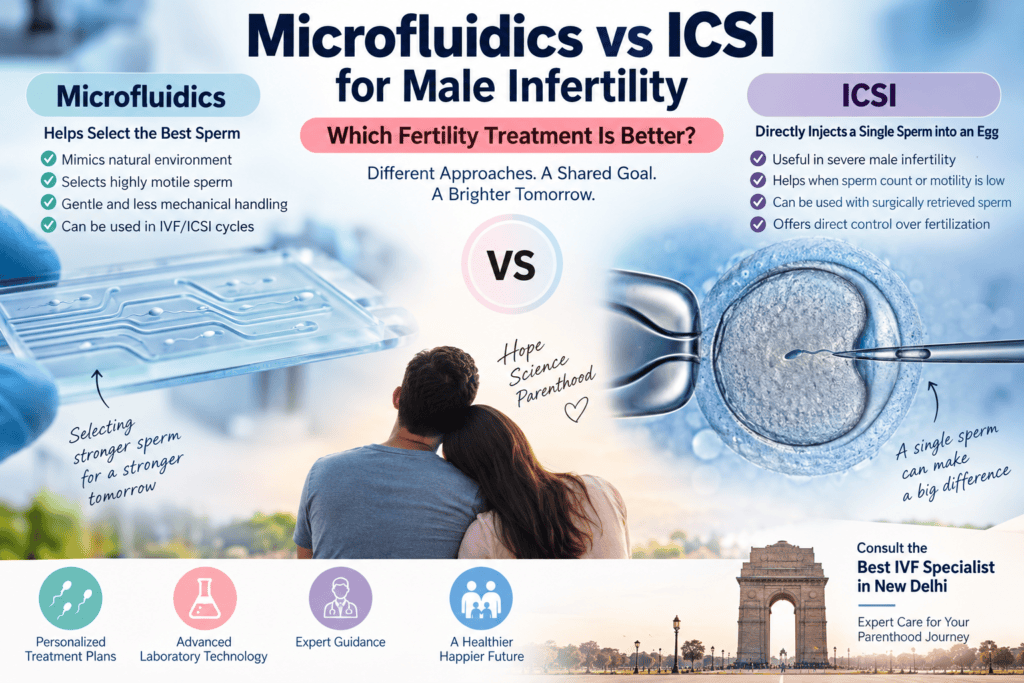
Learn how microfluidics and ICSI compare for male infertility, including their benefits, limitations, and applications, with guidance from the best IVF specialist in New Delhi for personalized treatment.
Of the two techniques, which one is better for treating male infertility? Once again, this depends on the couple’s fertility diagnosis, sperm characteristics, previous treatment history, and the fertility team’s recommendations.
Table of Contents
| Sr# | Headings |
|---|---|
| 1 | What Is Male Infertility? |
| 2 | What Is ICSI? |
| 3 | What Is Microfluidics in Fertility Treatment? |
| 4 | How Does Microfluidic Sperm Selection Work? |
| 5 | Microfluidics vs ICSI: Understanding the Difference |
| 6 | Benefits of ICSI for Male Infertility |
| 7 | Potential Benefits of Microfluidic Sperm Selection |
| 8 | Can Microfluidics and ICSI Be Used Together? |
| 9 | Microfluidics vs ICSI: Which Is Better? |
| 10 | When Might ICSI Be Recommended? |
| 11 | When Could Advanced Sperm Selection Be Considered? |
| 12 | Factors That Influence Fertility Treatment Success |
| 13 | How a Fertility Specialist Helps Choose the Right Treatment |
| 14 | Conclusion |
| 15 | Frequently Asked Questions |
What Is Male Infertility?
Factors that affect the male partner can lead to a diagnosis of male infertility. These can include a low sperm count, slow or no sperm movement, abnormal sperm shape, or problems with sperm production or delivery.
In some cases, there can be a combination of these factors. It is usually advantageous to consider the medical history of both partners to understand the possible cause of infertility.
A semen analysis is usually the first testing method used to evaluate sperm concentration, sperm movement, and sperm shape. Depending on the situation, additional tests may be recommended.
It is important to note that a diagnosis of male infertility does not mean that natural conception will never occur. The cause of male infertility will help determine the type of treatment offered, which can range from lifestyle changes and medications to surgery and assisted reproductive technologies.
What Is ICSI?
ICSI is an abbreviation for Intracytoplasmic Sperm Injection. It is a fertilization technique used during IVF procedures to help fertilize an egg by injecting a single sperm directly into a mature egg.
If fertilization is successful, the embryo can continue to develop and may later be considered for transfer to the uterus.
There are multiple factors that can make conventional fertilization difficult, and ICSI can be useful in some of those cases. These may include:
- Low sperm count
- Poor sperm motility
- Abnormal sperm morphology
- Previous IVF cycles with poor or failed fertilization
- Surgically retrieved sperm
- Severe male-factor infertility
Although ICSI can be useful in these situations, it is not necessarily a better option than standard IVF for every couple. The decision should always be assessed on an individual basis.
What Is Microfluidics in Fertility Treatment?
Microfluidics is a laboratory technology that can assist with sperm selection.
It is an interesting concept: sperm cells are required to travel through very small channels designed to represent certain elements of the natural environment through which sperm usually travel.
Compared with conventional laboratory methods, some microfluidic systems are designed to assist in selecting sperm with better motility and other desirable characteristics.
It is crucial to note that ICSI and microfluidics are two distinct procedures.
ICSI is focused on fertilization, while microfluidics is focused on sperm selection.
This is the key difference when comparing the two.
How Does Microfluidic Sperm Selection Work?
Picture the busiest section of a major highway. You can probably identify the vehicles that are able to move smoothly and efficiently compared with those that are stuck or moving very slowly. A microfluidic sperm-selection system creates similar conditions to help separate more progressively motile sperm from less desirable sperm using tiny channels.
A laboratory team prepares a semen sample and loads it into a microfluidic device. Depending on the specific technology, sperm with certain movement characteristics may move through the device more effectively.
Once the sperm have been selected, the laboratory team can proceed with the next steps of assisted reproduction.
One potential benefit is that this method may require less mechanical manipulation of sperm compared with some other methods of sperm preparation.
However, microfluidic sperm selection does not guarantee that the selected sperm are genetically normal, and it does not guarantee that pregnancy will occur.
Therefore, it should be considered a sperm-selection method rather than a standalone fertility treatment.
Microfluidics vs ICSI: Understanding the Difference
| Feature | Microfluidics | ICSI |
|---|---|---|
| Primary purpose | Sperm selection | Fertilization |
| Main focus | Identifying suitable sperm | Injecting one sperm into an egg |
| Stage | Before fertilization | During fertilization |
| Can address sperm selection? | Yes | The embryologist manually selects a sperm |
| Can fertilize an egg by itself? | No | Yes, as an IVF fertilization technique |
| May be combined with IVF? | Yes | Yes |
| Suitable for every patient? | No | No |
So, asking whether microfluidics is “better” than ICSI is somewhat like asking whether a good filter is better than a key. They perform different jobs.
In some treatment plans, the technologies may actually complement one another.
Benefits of ICSI for Male Infertility
One of the major advantages of ICSI is that it can overcome some barriers associated with sperm movement or sperm availability.
With conventional IVF, sperm are placed around an egg and must naturally penetrate the egg for fertilization to occur. With ICSI, the embryologist directly introduces one selected sperm into the egg.
This can be helpful when sperm have difficulty reaching or penetrating the egg.
Potential advantages include:
- Uses a single sperm for each injected egg
- Can be useful in severe male-factor infertility
- May help when previous IVF resulted in poor or failed fertilization
- Can be used with surgically retrieved sperm in appropriate cases
- Provides the embryology team with direct control over fertilization
Successful fertilization is only one part of fertility treatment. Embryo development, implantation, uterine factors, egg quality, and other variables can also influence the final outcome.
Microfluidic Sperm Selection: What’s the Big Deal?
Microfluidics has significant potential in assisted reproduction, especially in relation to sperm selection.
Traditional methods of sperm preparation can separate sperm based on characteristics such as movement and density. Microfluidics aims to create a more controlled environment to help isolate sperm with desired characteristics.
These characteristics may include:
- The ability to select sperm based on their movement
- Potentially less exposure to harsh laboratory conditions
- Less mechanical handling of sperm
- The ability to select a population of progressively motile sperm
- The potential to incorporate the technique into an assisted reproduction workflow
There are ongoing studies evaluating whether these laboratory advantages translate into an increase in pregnancy or live-birth rates.
It is important to make this distinction. Improving a laboratory measurement does not always result in a significant increase in the chance of having a baby.
Can Microfluidics and ICSI Be Used Together?
Yes. In selected cases, microfluidic sperm selection and ICSI can be used together.
For example, microfluidics may help the laboratory team select a population of sperm with favorable movement characteristics. The next step would be for an embryologist to select an individual sperm cell from that population for ICSI.
The entire process may look like this:
Semen sample → Sperm preparation → Microfluidic selection → Individual sperm selection → ICSI → Embryo development
This is where comparing microfluidics and ICSI can be somewhat misleading.
They can be used at the same time to accomplish two different yet complementary functions.
Microfluidics vs ICSI: Which Is Better?
There is no clear, unequivocal winner.
When there is significant male-factor infertility, ICSI may be an option because it involves the direct injection of a single sperm into an egg.
If the fertility team is seeking to improve sperm selection for assisted reproduction, microfluidics may be an option in appropriately selected cases.
When making a decision, several factors should be considered:
- Sperm count
- Progressive motility
- Sperm morphology
- Previous IVF/ICSI outcomes
- Number and quality of eggs
- Age of the female partner
- History of embryo development
- Availability of advanced laboratory techniques
- Underlying cause of infertility
Because of these factors, couples should not choose a fertility technology merely because it is the most modern option.
Not every newer technology is necessarily better for every patient.
If there is a good fit between the technology and the individual’s situation, an established technology may be more appropriate than an advanced technology.
When Would ICSI Be Suggested?
ICSI may be suggested when conventional fertilization is not likely to be successful.
A fertility specialist may suggest ICSI when there is a very low sperm count, poor sperm motility, previous fertilization failure, or sperm that has been collected surgically.
ICSI may also be considered in certain situations involving frozen sperm or specially retrieved sperm.
However, the complete fertility situation must be assessed before making this determination.
It must also be kept in mind that ICSI does not solve the underlying problem of suboptimal sperm production. Instead, it is a means of overcoming some of the barriers caused by poor sperm quality from a fertilization standpoint.
When Might Advanced Sperm Selection Be Used?
Advanced sperm-selection techniques may be considered when the fertility team determines that sperm selection could be valuable in developing a treatment plan.
Microfluidics may be an attractive option when the laboratory wishes to enrich a sample for progressively motile sperm while reducing certain manual processing steps.
Not all patients require an advanced sperm-selection technique.
In some cases, standard sperm preparation may be completely appropriate. In other cases, the fertility specialist and embryology team may consider additional laboratory techniques based on the specific clinical circumstances.
The aim should be to use the technology that is most appropriate for the couple.
An advanced reproductive laboratory technique should not be viewed in isolation. Many factors contribute to a successful outcome in assisted reproduction.
Even the best sperm selection, when combined with ICSI, cannot guarantee pregnancy.
Factors That Influence Fertility Treatment Success
Egg Quality and Age
Female age is an important factor in assisted reproduction because egg number and quality generally change over time. This can influence fertility and reproductive outcomes.
Sperm Quality
Sperm quality can also influence the outcome of a reproductive treatment cycle. Sperm count, motility, morphology, and other characteristics may be considered during fertility assessment.
Embryo Development
After fertilization, the embryo must develop appropriately. Embryo development is an important stage before an embryo can be considered for transfer.
Uterine and Endometrial Factors
The uterus and endometrium also play important roles in embryo implantation and pregnancy.
Medical Conditions
Infertility may be associated with hormonal, genetic, anatomical, or other medical factors. Identifying potential underlying causes can help guide treatment.
Laboratory Expertise
The standards and expertise of an embryology laboratory, along with its equipment and protocols, are important components of assisted reproduction.
Fertility treatment is a team effort, so it is best to think of it that way rather than as a single procedure.
How a Fertility Specialist Helps Choose the Right Treatment
While researching treatment options, you may come across a lot of information about the latest and supposedly most advanced sperm-selection techniques. However, how can you tell whether that information is relevant to you?
That is where a fertility specialist comes into play.
A specialist can evaluate the couple’s infertility history, the male partner’s semen analysis, previous treatment outcomes, female reproductive factors, and other relevant investigations.
When looking for the best IVF specialist in New Delhi, you should look beyond website rankings and promotional claims. Consider a specialist’s appropriate credentials, experience with male-factor infertility, access to a well-equipped embryology laboratory, transparent communication, and individualized approach to treatment.
During your consultation, you should ask:
- Why are you recommending ICSI in my case?
- Would conventional IVF be appropriate?
- Could microfluidic sperm selection be useful for me?
- What evidence supports using this technique in my situation?
- What are the alternatives?
- What are the expected benefits and limitations?
These questions can help you move beyond marketing claims and focus on your actual fertility needs.
Conclusion
Microfluidics and ICSI are not interchangeable. Microfluidics is a technology for sperm selection, while ICSI is a technique for fertilization. In some cases, they may be used together.
For male infertility, the best approach depends on male and female fertility factors, previous treatments, sperm characteristics, and the expertise of the fertility team.
Instead of asking which technology is newest, a better question is: Which technique is most appropriate for our individual fertility situation?
An individual assessment with a qualified fertility specialist can help you understand your available options and choose a treatment strategy based on your reproductive goals.
Frequently Asked Questions
1. Is microfluidics superior to ICSI for male infertility?
No. They serve different purposes. Microfluidics is used for sperm selection, whereas ICSI is a fertilization technique that involves directly injecting a single sperm into an egg. In some cases, both techniques may be used together.
2. Can microfluidics improve the success rate of IVF?
Microfluidics may help select sperm with favorable movement characteristics. However, improved laboratory sperm selection does not necessarily lead to improved clinical pregnancy or live-birth rates. Its use depends on the specific clinical situation and available evidence.
3. Who can benefit from ICSI?
ICSI may be considered in cases of significant male-factor infertility, such as very low sperm numbers, poor sperm movement, certain previous fertilization failures, or situations where sperm have been surgically retrieved.
4. Can microfluidics be used prior to ICSI?
Yes. In selected fertility-treatment protocols, sperm that have undergone microfluidic selection may subsequently be used for ICSI. The exact approach depends on the clinical circumstances and the laboratory’s protocols.
5. How do I pick the best IVF specialist in New Delhi?
When looking for the best IVF specialist in New Delhi, consider factors such as qualifications, experience, expertise in male-factor infertility, embryology laboratory facilities, counseling, and the specialist’s personalized approach. Look for a specialist who is willing to explain why a particular technique is being recommended and what alternatives may be available.