Introduction
Have you ever felt unusual heaviness or bloating in your lower abdomen and wondered, “Am I pregnant?” even when you know you’re not? You’re not alone. Many women experience an enlarged uterus without pregnancy, and it can feel confusing or even scary.
Think of your uterus like a balloon. During pregnancy, it expands naturally. But what if that balloon grows bigger without a baby inside? Conditions such as uterine fibroids often arise at this point.
In this article, we’ll break everything down in simple language—what causes an enlarged uterus, how fibroids play a role, and when you should seek help from the best IVF doctor in Delhi NCR.
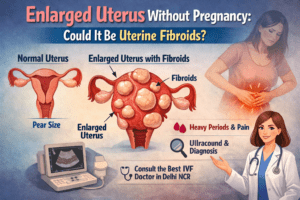
Table of Contents
| Sr# | Headings |
|---|---|
| 1 | What is an Enlarged Uterus? |
| 2 | Common Causes of Enlarged Uterus |
| 3 | What are Uterine Fibroids? |
| 4 | Why Do Fibroids Develop? |
| 5 | Symptoms of Uterine Fibroids |
| 6 | How Fibroids Cause Uterine Enlargement |
| 7 | Other Conditions That Can Enlarge the Uterus |
| 8 | When Should You See a Doctor? |
| 9 | Diagnosis: How is the Cause Identified? |
| 10 | Treatment Options for Fibroids |
| 11 | Impact on Fertility and Pregnancy |
| 12 | Lifestyle Tips to Manage Symptoms |
| 13 | When Surgery is Needed |
| 14 | Importance of Early Detection |
| 15 | Choosing the Right Specialist |
1. What is an enlarged uterus?
A larger abdomen simply means that your uterus is larger than its normal size. In normal circumstances, it’s around the size of a pear. However, under certain conditions, it could grow to the size of a grapefruit or more.
The enlargement might not be a cause of discomfort; however, for some women, it can cause discomfort, heavy menstrual flow or pressure on the abdomen.
2. Common Causes of Enlarged Uterus
Many conditions can cause uterine enlargement.
- Fibroids from the uterus (most commonly)
- Adenomyosis
- Endometrial thickening
- Hormonal imbalances
- Rare tumors
From the aforementioned, fibroids are the primary cause for most often for women between the ages of 30 and 50.
3. What are Uterine Fibroids?
Uterine fibroids are benign growths that form within, or in the vicinity of, the uterus. They may be as small as seeds or huge like the size of a melon.
Consider fibroids like “extra lumps of muscle tissue” that are growing in places they should not. Although they’re generally benign, they may create significant discomfort based on their size and location.
4. Why Do Fibroids Develop?
The cause of the problem isn’t completely identified; however, several aspects contribute to the problem:
- Hormones (estrogen and progesterone)
- Genetic influences
- Family heritage
- Obesity
- Delayed pregnancy
Fibroids are more likely to grow during periods of reproductive age when hormone levels are high.
5. Symptoms of Uterine Fibroids
The fibroids of every woman are afflicted with symptoms. When they do manifest, they could include:
- Extended or long-lasting time
- Pain in your pelvis or pressure
- Frequent urination
- Constipation
- Lower back Pain in the lower back
- Abdominal swelling visible
It might even feel as if it’s an early pregnancy, which can be confusing.
6. How Fibroids Cause Uterine Enlargement
Fibroids are found inside or along the uterine wall. As they grow in size or quantity, they push against the uterine walls, causing the uterus to grow.
Imagine placing several small balls in a balloon. The balloon expands to accommodate them. In the same way, fibroids expand the uterus, which leads to an expansion.
7. Other Conditions That Can Enlarge the Uterus
Although fibroids are common, they’re not the sole reason. Other possible causes are:
Adenomyosis
This happens when the inner lining of the uterus expands into the muscle wall.
Endometrial Hyperplasia
Inflammation of the uterine lining because of a hormonal imbalance.
Ovarian Cysts or Tumours
They could be a sign of the enlargement of the uterus.
8. When Should You See a Doctor?
Consult a doctor if you observe:
- Persistent pelvic pain
- Acute bleeding that affects everyday life
- Rapid abdominal growth
- The difficulty in understanding
An early appointment with the IVF doctor in Delhi NCR will assist in identifying the problem prior to it getting worse.
9. Diagnosis: How is the Cause Identified?
Doctors employ a variety of methods to diagnose the problem:
- Pelvic examination
- Ultrasound scan
- MRI (in complicated cases)
- Blood tests
These tests can help determine if fibroids or other conditions are the cause.
10. Treatment Options for Fibroids
Treatment varies based on symptoms, age, and fertility goals.
Medications
- Hormonal therapy
- Pain relief medicines
Non-Surgical Options
- Uterine embolisation of the artery
- Procedures guided by MRI
Minimally Invasive Surgery
- Laparoscopic myomectomy
11. Impact on Fertility and Pregnancy
Sometimes, fibroids can impact fertility via:
- Blocking fallopian tubes
- The uterus is distorted
- Influencing the implantation
Yet, many women who suffer from fibroids are still able to conceive by following the correct treatment and advice from the most skilled IVF physician in Delhi NCR.
12. Lifestyle Tips to Manage Symptoms
Although lifestyle changes will not eliminate fibroids, they can assist alleviate symptoms:
- Maintain your weight in a healthy range.
- Eat iron-rich foods
- Reduce processed food items
- Exercise regularly
- Manage stress
13. When Surgery is Needed
Surgery may be suggested in the following situations:
- Fibroids are extremely large
- The symptoms are serious
- The condition of fertility can affect fertility
The most common surgical options are:
- Myomectomy (fibroid removal)
- Hysterectomy (uterus removal in severe cases)
14. Importance of Early Detection
The inability to recognise symptoms can result in complications such as:
- Anemia severe
- Chronic pain
- Problems with fertility
Early detection makes treatment simpler and more efficient.
15. Choosing the Right Specialist
Selecting an appropriate doctor essential. Be sure to look for:
- Experiments in managing fibroids
- Expertise in fertility treatments
- Advanced diagnostic capabilities
Engaging the IVF doctor in Delhi NCR will ensure that you receive individualised and effective treatment, particularly in cases where fertility is an issue.
Conclusion
An enlarged uterus, even without pregnancy, can be alarming; however, in most cases,s it’s due to fibroids in the uterus that are quite normal and easily treated.
It is important not to ignore the body’s signals. If it’s heavy menstrual flow, pelvic discomfort or bloating that isn’t explained, these signs need to be taken seriously.
With a prompt diagnosis and skilled treatment, you can control fibroids efficiently and also keep your fertility. If you’re not sure you’re not sure, do not hesitate to speak with the IVF specialist with the best reputation in Delhi NCR for advice and assurance.
FAQs
1. An enlarged uterus could be misinterpreted as a pregnancy.
Yes, an enlarged uterus caused by fibroids could appear similar to pregnancy symptoms such as abdominal swelling and bloating.
2. Are uterine fibroids dangerous?
The majority of fibroids are benign and harmless, but they may cause discomfort and even complications when left untreated.
3. Are fibroids able to disappear by themselves?
Small fibroids can shrink after menopausal change; however, they typically don’t disappear completely if treated.
4. Do fibroids always require surgery?
Yes, most fibroids can be treated by non-surgical or medication treatments according to the symptoms.
5. Do I have a chance of getting pregnant when I have fibroids?
Yes, a large number of women with fibroids can conceive successfully, particularly with the right medical care and support.