
Introduction
If you’ve been diagnosed with PCOD (Polycystic Ovarian Disease) and are trying to conceive, you might have heard people say, “You’ll probably need IVF.” That statement can sound scary, confusing, and overwhelming.
But here’s the truth: IVF is not always the first or only solution for PCOD.
Many women with PCOD conceive naturally or with simpler fertility treatments. Think of fertility treatment like climbing a staircase—you don’t jump straight to the top step. Doctors usually start with the simplest solutions before moving to advanced treatments like IVF.
In this guide, we’ll explore whether IVF is truly necessary for PCOD, what treatment options exist, and when it’s time to consult the best IVF Doctor in Delhi NCR for expert help.
Table of Contents
| Sr# | Headings |
|---|---|
| 1 | Understanding PCOD |
| 2 | Why PCOD Affects Fertility |
| 3 | Is Pregnancy Possible Naturally with PCOD? |
| 4 | Early Treatment Options for PCOD |
| 5 | Lifestyle Changes That Improve Fertility |
| 6 | Medications for Ovulation in PCOD |
| 7 | When Doctors Recommend Fertility Treatments |
| 8 | IUI vs IVF: What’s the Difference? |
| 9 | When IVF Becomes Necessary |
| 10 | Success Rates of IVF for PCOD Patients |
| 11 | Choosing the Best IVF Doctor in Delhi NCR |
| 12 | Emotional and Mental Aspects of PCOD Fertility |
| 13 | Common Myths About PCOD and IVF |
| 14 | Tips to Improve Fertility with PCOD |
| 15 | When to See a Fertility Specialist |
1. Understanding PCOD
PCOD (Polycystic Ovarian Disease) is a hormonal condition that affects many women of reproductive age.
In PCOD, the ovaries may produce many immature eggs, which can form small cysts. These cysts disrupt normal ovulation and hormone balance.
Common symptoms include:
Irregular periods
Weight gain
Acne
Excess facial hair
Difficulty getting pregnant
However, PCOD affects every woman differently, and not all women experience infertility.
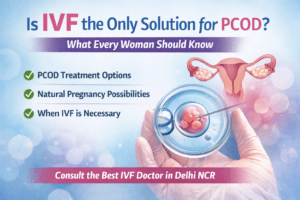
2. Why PCOD Affects Fertility
To understand fertility problems in PCOD, imagine the ovary as a fruit tree.
Every month, the tree should release one ripe fruit (an egg). But in PCOD, many small fruits start growing but none fully ripen.
As a result:
Ovulation may not happen regularly
Hormonal imbalance occurs
Egg release becomes unpredictable
This is why some women with PCOD struggle to conceive.
3. Is Pregnancy Possible Naturally with PCOD?
Yes, many women with PCOD conceive naturally.
In fact, doctors estimate that a large percentage of women with PCOD can get pregnant without IVF.
Natural pregnancy is possible when:
Ovulation occurs regularly
Hormones are balanced
Lifestyle factors are managed
Some women only need minor lifestyle changes or medications to improve ovulation.
4. Early Treatment Options for PCOD
Doctors rarely jump directly to IVF. Instead, they follow a step-by-step approach.
Common early treatments include:
Lifestyle modification
Ovulation-inducing medicines
Hormone regulation
Insulin resistance management
These treatments often restore natural ovulation.
For many couples, pregnancy happens within months of starting treatment.
5. Lifestyle Changes That Improve Fertility
Lifestyle plays a huge role in managing PCOD.
Even losing 5– 10% of body weight can significantly improve fertility.
Important changes include:
Healthy diet
Focus on:
Whole grains
Lean proteins
Fruits and vegetables
Low sugar intake
Regular exercise
Exercise helps regulate hormones and insulin levels.
Stress management
Chronic stress can worsen hormonal imbalance.
Think of your body like a delicate orchestra– when one instrument goes off rhythm, the entire harmony changes.
6. Medications for Ovulation in PCOD
If lifestyle changes alone aren’t enough, doctors may prescribe medications.
Common fertility medicines include:
Ovulation induction drugs
These medications stimulate the ovaries to release eggs.
Hormonal regulation medicines
They help restore hormonal balance.
Insulin-sensitizing drugs
These are useful when PCOD is linked with insulin resistance.
Many women conceive within the first few treatment cycles using these medications.
7. When Doctors Recommend Fertility Treatments
If ovulation medicines don’t work, doctors may suggest assisted fertility treatments.
Factors that influence treatment decisions include:
Age of the woman
Duration of infertility
Male partner fertility
Hormone levels
Ovarian reserve
A fertility specialist will carefully evaluate all these factors before suggesting IVF.
8. IUI vs IVF: What’s the Difference?
Before IVF, many doctors recommend IUI (Intrauterine Insemination).
IUI
Sperm is placed directly into the uterus
Less invasive
More affordable
IVF
Eggs are fertilized in a lab
Embryos are transferred into the uterus
Higher success rates for certain cases
Doctors usually try IUI first before recommending IVF.
9. When IVF Becomes Necessary
IVF may be recommended in certain PCOD cases, such as:
Ovulation treatments fail
Blocked fallopian tubes
Severe male infertility
Long-term infertility
Advanced maternal age
In these situations, IVF significantly increases pregnancy chances.
Consulting the best IVF Doctor in Delhi NCR can help determine whether IVF is truly required.
10. Success Rates of IVF for PCOD Patients
Interestingly, women with PCOD often have good IVF success rates.
This is because PCOD ovaries usually produce more eggs, which can increase the number of embryos available.
However, doctors must carefully manage treatment to prevent ovarian hyperstimulation syndrome (OHSS).
With proper medical guidance, IVF outcomes can be very encouraging.
11. Choosing the Best IVF Doctor in Delhi NCR
Selecting the right fertility specialist is extremely important.
A skilled doctor can:
Identify the exact cause of infertility
Avoid unnecessary treatments
Personalize fertility plans
Improve success rates
When searching for the best IVF Doctor in Delhi NCR, consider:
Experience in fertility treatments
Success rates
Advanced IVF technology
Patient reviews
Transparent consultation
Remember, fertility treatment is not just medical– it’s deeply emotional.
You need a doctor who understands both.
12. Emotional and Mental Aspects of PCOD Fertility
Fertility struggles can affect emotional well-being.
Women with PCOD often experience:
Anxiety
Stress
Social pressure
Self-doubt
It’s important to remember:
Infertility is a medical condition, not a personal failure.
Support from family, counseling, and fertility specialists can make the journey easier.
13. Common Myths About PCOD and IVF
Let’s clear up some myths.
Myth 1: Every PCOD patient needs IVF
Not true. Many conceive naturally.
Myth 2: PCOD always causes infertility
Many women with PCOD become mothers.
Myth 3: IVF guarantees pregnancy
IVF improves chances but does not guarantee success.
Myth 4: PCOD means you can never ovulate
Ovulation can often be restored with treatment.
14. Tips to Improve Fertility with PCOD
Here are practical tips to boost fertility:
Maintain healthy weight
Exercise regularly
Follow a balanced diet
Track menstrual cycles
Manage stress
Sleep well
Avoid smoking and alcohol
These small steps can significantly improve reproductive health.
15. When to See a Fertility Specialist
You should consult a fertility expert if:
You’ve tried to conceive for 12 months without success
Your periods are highly irregular
You are over 35 years old
PCOD symptoms are severe
A consultation with the best IVF Doctor in Delhi NCR can help create a personalized treatment plan.
Conclusion
So, is IVF the only solution for PCOD?
Absolutely not.
For many women, simple treatments such as lifestyle changes, medications, or ovulation therapy are enough to achieve pregnancy.
IVF is typically recommended only when other options don’t work or when additional fertility issues exist.
The key is early diagnosis, proper treatment, and guidance from an experienced fertility specialist. With the right approach, many women with PCOD go on to have healthy pregnancies and successful motherhood journeys.
FAQs
1. Can women with PCOD get pregnant naturally?
Yes. Many women with PCOD conceive naturally, especially with lifestyle changes and ovulation treatments.
2. Is IVF always required for PCOD patients?
No. IVF is usually considered only when simpler treatments like ovulation induction or IUI fail.
3. What is the best age to treat PCOD-related infertility?
Fertility treatments are most effective when started before age 35, but successful pregnancies can occur later as well.
4. How long should PCOD patients try before seeing a fertility doctor?
If pregnancy does not occur after 12 months of trying, consulting a fertility specialist is recommended.
5. How do I find the best IVF Doctor in Delhi NCR?
Look for experienced fertility specialists with strong success rates, advanced technology, and positive patient reviews in reputed fertility clinics.