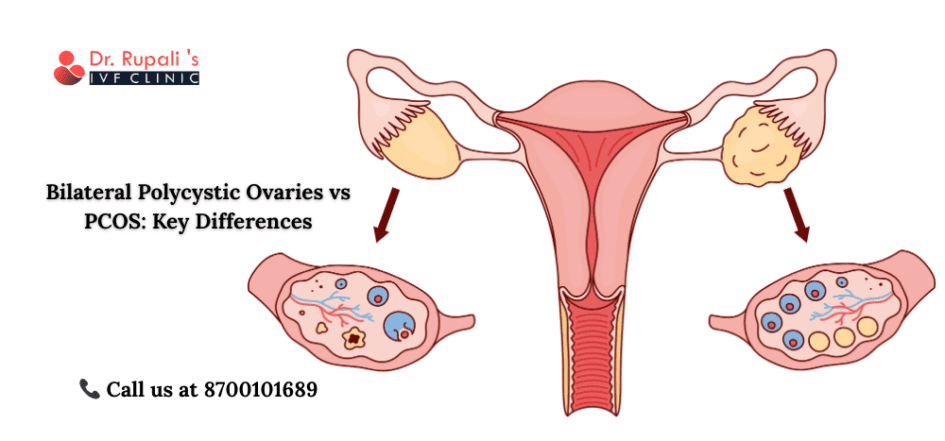
If you’ve ever gone through an ultrasound and heard the words “bilateral polycystic ovaries,” your mind probably raced. Does this mean PCOS? Does it affect fertility? Should you be worried? You’re not alone. Many women feel confused because these terms are often used interchangeably– when in reality, they’re not the same.
Think of it like this: having clouds in the sky doesn’t always mean it will rain. Similarly, having polycystic-looking ovaries doesn’t automatically mean you have PCOS. In this article, we’ll break down the difference in plain English, without medical jargon, so you can understand what’s really going on with your body
Confused between bilateral polycystic ovaries and PCOS? Learn key differences, fertility effects, and when to consult the best ivf specialist in New Delhi.
1. Understanding the Basics
Let’s start simple. Bilateral means both sides. So when doctors say bilateral polycystic ovaries, they’re describing what they see in both ovaries on an ultrasound. PCOS, on the other hand, is a full medical condition involving hormones, periods, and sometimes fertility.
Understanding this difference is the first step toward peace of mind.
- What Are Bilateral Polycystic Ovaries?
Bilateral polycystic ovaries refer to an ultrasound finding, not a disease. It simply means:
Both ovaries contain multiple small follicles
Ovaries may appear slightly enlarged
No symptoms may be present at all
Many women with this finding:
Have regular periods
Have no hormonal issues
Get pregnant naturally
In short, it’s a picture, not a problem.
- What Is PCOS (Polycystic Ovary Syndrome)?
PCOS is a hormonal disorder that affects how a woman’s ovaries function. It’s diagnosed when at least two of the following are present:
Irregular or absent periods
Signs of excess male hormones (acne, facial hair, hair thinning).
Polycystic ovaries on ultrasound.
PCOS affects the whole body– not just the ovaries.
- Why These Two Terms Are Often Confused.
Here’s where confusion begins. Polycystic ovaries are one feature of PCOS, but not everyone with polycystic ovaries has PCOS.
Doctors sometimes shorten explanations, and patients hear “polycystic” and assume the worst. But context matters– a lot.
- Key Differences at a Glance.
Bilateral Polycystic Ovaries.
Ultrasound finding.
May have no symptoms.
Hormones often normal.
Periods usually regular.
PCOS.
Hormonal condition.
Multiple symptoms.
Irregular periods common.
May affect fertility.
This difference is crucial when planning treatment.
- Symptoms: What You May or May Not Feel.
With bilateral polycystic ovaries, many women feel completely normal.
With PCOS, symptoms can include:.
Irregular periods.
Weight gain.
Acne or oily skin.
Excess facial or body hair.
Difficulty getting pregnant.
If your body is sending mixed signals, it’s worth investigating further.
- Hormonal Imbalance: The Real Game Changer.
Here’s the heart of the matter. PCOS is driven by hormonal imbalance, especially higher levels of androgens (male hormones).
Bilateral polycystic ovaries do not automatically mean hormonal imbalance. Blood tests are often normal.
That’s why blood work is just as important as ultrasound.
- Diagnosis: How Doctors Tell Them Apart.
A proper diagnosis includes:.
Detailed medical history.
Menstrual cycle tracking.
Hormone blood tests.
Ultrasound imaging.
Relying only on ultrasound can lead to misdiagnosis– and unnecessary stress.
- Impact on Menstrual Cycles.
Bilateral polycystic ovaries:.
Periods are usually on time.
PCOS:.
Periods may be delayed, irregular, or absent.
Your cycle is like a monthly report card– it tells doctors a lot about what’s happening inside.
- Fertility and Pregnancy Concerns.
This is where many women worry the most.
Bilateral polycystic ovaries: Fertility is often normal.
PCOS: Ovulation may be irregular, making conception harder.
The good news? With proper care, most women with PCOS do conceive, sometimes naturally and sometimes with medical help.
- Treatment Options for Both Conditions.
Bilateral Polycystic Ovaries.
Often no treatment needed.
Regular monitoring.
PCOS.
Hormone regulation.
Ovulation-inducing medicines.
Insulin-sensitizing drugs (if needed).
Treatment is personalized– there’s no one-size-fits-all.
- Lifestyle Changes That Make a Difference.
Small changes can create big wins:.
Balanced diet.
Regular physical activity.
Stress management.
Quality sleep.
For PCOS, lifestyle changes can be as powerful as medication.
- When IVF Comes Into the Picture.
If other treatments don’t work, IVF may be recommended, especially for women with long-standing PCOS-related infertility.
This is where choosing the best ivf specialist in new delhi becomes important– experience matters when hormones and ovaries need careful handling.
- Choosing the Right Fertility Expert.
Look for someone who:.
Explains, not rushes.
Treats you as a person, not a report.
Has proven experience with PCOS and IVF.
The best ivf specialist in new delhi will focus on accurate diagnosis before jumping to advanced treatments.
- Emotional and Mental Health Aspects.
Let’s not ignore this. Confusing diagnoses can cause anxiety, self-doubt, and fear about the future.
Talking openly, seeking support, and getting clear answers can make this journey far less overwhelming.
Conclusion.
So, are bilateral polycystic ovaries and PCOS the same? No, not at all. One is a visual finding, the other a hormonal condition. Knowing the difference can save you from unnecessary worry and help you take the right next step– whether that’s simple monitoring, lifestyle changes, or consulting the best ivf specialist in new delhi for fertility support.
Your body isn’t broken. It’s just asking to be understood.
Frequently Asked Questions (FAQs).
- Can bilateral polycystic ovaries turn into PCOS?
No, they don’t “turn into” PCOS. However, hormonal changes later in life may lead to PCOS symptoms. - Do all women with PCOS have polycystic ovaries?
No. Some women with PCOS have normal-looking ovaries on ultrasound. - Is fertility always affected in PCOS?
Not always. Many women conceive naturally or with minimal treatment. - Should I worry if my ultrasound shows bilateral polycystic ovaries?
Not necessarily. If your periods and hormones are normal, it may not be a concern. - When should I consult an IVF specialist?
If you’ve been trying to conceive for over a year (or 6 months if over 35), consulting the best ivf specialist in new delhi can help clarify your options.