Introduction
Trying to conceive can become confusing when you are told that your fallopian tubes are blocked or that your egg count is low. You may naturally wonder: Can I still get pregnant? Is IVF the only option? Should I wait or start treatment now?
The good news is that these conditions do not automatically mean pregnancy is impossible. Fertility treatment can often work around blocked tubes, while a low ovarian reserve can help doctors plan treatment more carefully.
Think of the fallopian tubes as a pathway connecting the ovary and uterus. If that pathway is blocked, the egg and sperm may not be able to meet naturally. IVF provides another route by allowing fertilisation to take place in a laboratory before the embryo is placed into the uterus.
If you are considering treatment, consulting an experienced fertility specialist, such as the best IVF Doctor in Delhi NCR, can help you understand your individual options rather than relying on a single test result.
Table of Contents
| Sr# | Headings |
|---|---|
| 1 | What Are Blocked Fallopian Tubes? |
| 2 | What Does Low Egg Count Mean? |
| 3 | Can Blocked Tubes and Low Egg Count Occur Together? |
| 4 | What Causes Blocked Fallopian Tubes? |
| 5 | How Are Blocked Tubes Diagnosed? |
| 6 | How Is Low Egg Count Evaluated? |
| 7 | Can You Get Pregnant Naturally With Blocked Tubes? |
| 8 | When Is IVF Considered for Blocked Tubes? |
| 9 | When May IVF Be Considered for Low Egg Count? |
| 10 | How IVF Helps When Tubes Are Blocked |
| 11 | What Factors Affect IVF Success? |
| 12 | Can Tubal Surgery Be an Alternative to IVF? |
| 13 | Questions to Ask Your IVF Specialist |
| 14 | Conclusion |
| 15 | FAQs |
1. What Are Blocked Fallopian Tubes?
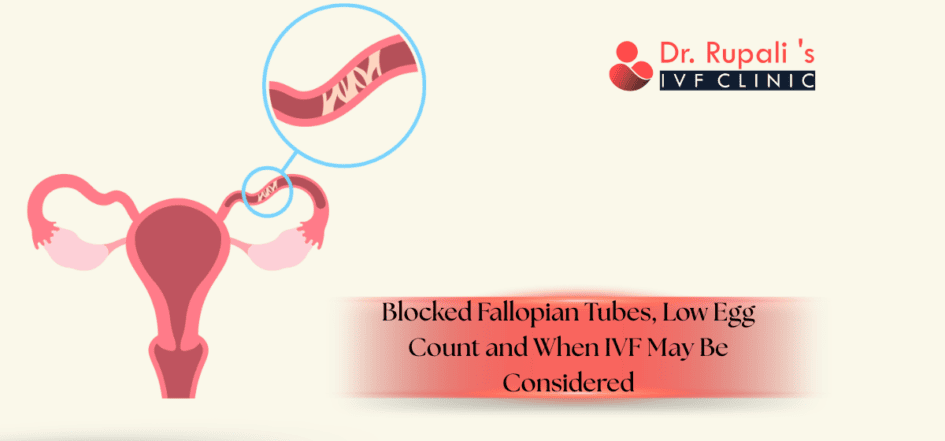
The fallopian tubes are two narrow tubes that connect the ovaries with the uterus. During natural conception, an egg released from an ovary travels into a fallopian tube. Sperm must reach the egg there, and after fertilisation, the early embryo travels toward the uterus.
When a tube is blocked, this process may be disrupted.
One blocked fallopian tube does not always mean pregnancy is impossible. If the other tube is healthy and ovulation occurs from the corresponding ovary, natural conception may still happen.
However, both fallopian tubes being blocked can make natural conception much more difficult, because the egg and sperm cannot normally meet.
The location and severity of the blockage also matter. A blockage may occur near the uterus, in the middle portion of the tube, or closer to the ovary.
According to the American Society for Reproductive Medicine (ASRM), tubal disease is an important cause of infertility and should be specifically evaluated during an infertility assessment.
2. What Does Low Egg Count Mean?
When people say they have a low egg count, they are usually referring to diminished ovarian reserve (DOR).
Ovarian reserve refers to the remaining number of eggs in the ovaries. It is different from egg quality. A woman can have a reduced ovarian reserve but still potentially produce an egg capable of fertilisation and pregnancy.
Doctors commonly assess ovarian reserve using:
- AMH (Anti-Müllerian Hormone)
- Antral follicle count (AFC) on ultrasound
- FSH and other hormone tests, when appropriate
- Age and reproductive history
- Previous response to fertility treatment
AMH and AFC are useful for estimating how the ovaries may respond to stimulation during IVF. However, they are not perfect tests of whether a woman can become pregnant. ASRM notes that ovarian reserve tests are better at predicting egg yield during IVF than independently predicting pregnancy or live birth.
This distinction is extremely important.
A low AMH does not automatically mean you cannot become pregnant.
3. Can Blocked Tubes and Low Egg Count Occur Together?
Yes. A woman can have both tubal blockage and diminished ovarian reserve.
For example, previous pelvic infection or surgery may have damaged the fallopian tubes, while age-related changes may have reduced ovarian reserve.
When both conditions are present, the fertility plan needs to consider several factors at the same time.
These include:
- Age
- AMH level
- Antral follicle count
- Whether one or both tubes are blocked
- Location and severity of tubal disease
- Sperm quality
- Previous pregnancies
- Previous fertility treatments
- Overall reproductive health
This is why it is usually not helpful to look at one report in isolation.
A low AMH result tells your doctor something about the expected ovarian response, while a tubal test tells your doctor about the reproductive pathway. Together, these results can help shape an appropriate treatment strategy.
4. What Causes Blocked Fallopian Tubes?
Several conditions can cause fallopian tube damage or blockage.
Common causes include:
Pelvic inflammatory disease: Certain infections can cause inflammation and scarring around the reproductive organs.
Endometriosis: Endometriosis can lead to inflammation, adhesions and changes around the tubes and ovaries.
Previous pelvic or abdominal surgery: Surgery may sometimes result in scar tissue or adhesions.
Previous ectopic pregnancy: An ectopic pregnancy can damage a fallopian tube and may sometimes require surgical treatment.
Tubal sterilisation: Previous tubal ligation intentionally interrupts the fallopian tubes.
Certain infections: Some untreated reproductive tract infections can cause tubal damage.
ACOG also identifies fallopian tube scarring or blockage, including damage associated with infections or endometriosis, as a possible cause of infertility.
5. How Are Blocked Tubes Diagnosed?
You cannot reliably determine whether your fallopian tubes are blocked simply from symptoms.
In fact, many women with blocked tubes have no obvious symptoms.
Doctors may use several tests depending on your medical history.
Hysterosalpingography (HSG)
An HSG is an imaging test that uses contrast material and X-rays to assess the uterus and whether the fallopian tubes allow the contrast to pass through.
It is commonly used as an initial assessment of tubal patency.
Ultrasound-Based Tests
Certain ultrasound examinations can provide information about the uterus and reproductive organs. In selected circumstances, a contrast-enhanced ultrasound may also be used to assess tubal patency.
Laparoscopy
Laparoscopy is a minimally invasive surgical procedure that can allow doctors to examine the reproductive organs directly and identify conditions such as adhesions or endometriosis.
Not every woman needs every test. The appropriate evaluation depends on the individual’s symptoms, history and previous results. ACOG notes that infertility evaluations may include ultrasound, HSG, hysteroscopy or laparoscopy depending on the circumstances.
6. How Is Low Egg Count Evaluated?
Low ovarian reserve is generally evaluated using a combination of medical history, age, hormone testing and ultrasound.
AMH Test
AMH is produced by small ovarian follicles and is commonly used as a marker of ovarian reserve.
Antral Follicle Count
A transvaginal ultrasound can count small follicles in the ovaries. This is known as the antral follicle count (AFC).
FSH and Other Tests
FSH may provide additional information, particularly when ovarian reserve appears to be significantly reduced.
However, these tests should be interpreted by a fertility specialist rather than treated as a simple pass-or-fail fertility test.
ASRM specifically states that ovarian reserve tests measure quantity more than quality, and age remains a major factor in reproductive potential.
7. Can You Get Pregnant Naturally With Blocked Tubes?
The answer depends on whether one or both tubes are affected.
If only one tube is blocked, natural pregnancy may still be possible if the other tube is healthy and other fertility factors are favourable.
If both tubes are completely blocked, natural conception becomes much more difficult because the egg and sperm generally cannot meet.
But there is another important point: not every apparent blockage means permanent damage.
For example, certain test results suggesting blockage, particularly near the uterus, may sometimes require further evaluation to confirm whether the obstruction is genuine. ASRM notes that findings suggesting bilateral proximal obstruction should be evaluated further because technical factors or temporary tubal contractions can sometimes mimic blockage.
Therefore, before making a major treatment decision, it is worth confirming the diagnosis with an experienced specialist.
8. When Is IVF Considered for Blocked Tubes?
IVF is often considered when the fallopian tubes are significantly damaged or blocked and surgery is unlikely to provide a meaningful benefit.
Why?
Because IVF bypasses the fallopian tubes.
During IVF, the ovaries are stimulated to develop follicles. Eggs are collected from the ovaries and fertilised with sperm in a laboratory. The resulting embryo is then transferred into the uterus.
This means the egg does not need to travel through the fallopian tube for fertilisation.
ACOG lists damaged or blocked fallopian tubes that cannot be treated surgically among the situations in which IVF may be used.
IVF may be particularly attractive when there are additional fertility concerns, such as:
- Bilateral tubal blockage
- Significant tubal damage
- Advanced reproductive age
- Low ovarian reserve
- Male-factor infertility
- Endometriosis
- Previous unsuccessful fertility treatments
The exact decision should be personalised.
9. When May IVF Be Considered for Low Egg Count?
A low egg count does not automatically mean IVF is necessary. However, IVF may be considered when diminished ovarian reserve is affecting fertility, particularly when age or other infertility factors are also involved.
The main challenge with low ovarian reserve during IVF is often the number of eggs obtained after stimulation.
A lower ovarian reserve may mean fewer follicles respond to stimulation and fewer eggs are retrieved.
However, there is an important message for anyone with a low AMH:
A low AMH should not automatically be interpreted as “IVF will not work.”
ASRM states that even very low AMH should not be used by itself to refuse IVF treatment. AMH and AFC are useful for anticipating ovarian response, but they have only a weak independent relationship with pregnancy and live birth outcomes.
Your age, embryo development, sperm quality, uterine health and laboratory factors also influence the outcome.
10. How IVF Helps When Tubes Are Blocked
One of the biggest advantages of IVF is that it can effectively work around the fallopian tubes.
The process generally involves several stages:
1. Ovarian stimulation: Fertility medicines encourage multiple follicles to develop.
2. Monitoring: Ultrasound and sometimes hormone testing are used to monitor follicular development.
3. Egg retrieval: Mature eggs are collected using a procedure guided by ultrasound.
4. Fertilisation: Eggs are fertilised with sperm in the laboratory. In some cases, a single sperm may be injected into an egg, a technique known as ICSI.
5. Embryo development: Fertilised eggs are monitored as they develop into embryos.
6. Embryo transfer: A selected embryo is placed into the uterus.
The fallopian tubes are therefore not required for the egg and sperm to meet during IVF.
This is why IVF can be an important option for women with significant tubal-factor infertility.
11. What Factors Affect IVF Success?
Many people focus heavily on AMH or egg count, but IVF success is influenced by multiple factors.
Age
Age is one of the strongest factors affecting reproductive outcomes because egg quality generally declines with age.
Ovarian Reserve
Ovarian reserve can influence the number of eggs obtained during stimulation.
Embryo Quality
The ability of an embryo to develop and implant is important.
Sperm Quality
Male-factor infertility can affect fertilisation and embryo development.
Uterine Health
The condition of the uterus and endometrium can influence implantation.
Fertility Clinic and Laboratory
The expertise of the fertility team, embryology laboratory and treatment protocols also matter.
Therefore, a low egg count should never be used as the only predictor of your IVF outcome.
A fertility specialist can assess your complete situation and explain what your individual chances may look like.
12. Can Tubal Surgery Be an Alternative to IVF?
Sometimes, yes.
Tubal surgery may be considered in selected women depending on the location and severity of the blockage, age, ovarian reserve, sperm quality and other fertility factors.
However, surgery is not automatically better than IVF.
ASRM explains that treatment decisions between tubal surgery and IVF should consider several factors, including the type of tubal disease and the patient’s overall fertility situation.
For example, IVF may be preferred when:
- The woman is older
- Ovarian reserve is low
- Both tubes are severely damaged
- There is significant male-factor infertility
- Previous tubal surgery has failed
- There are additional fertility problems
In contrast, carefully selected patients with certain forms of tubal disease may benefit from surgical treatment.
The key is individualised decision-making rather than choosing treatment based on one diagnosis alone.
13. Questions to Ask Your IVF Specialist
If you have blocked fallopian tubes and a low egg count, your consultation should be an opportunity to understand your complete fertility picture.
Consider asking:
Are both of my tubes blocked, or only one?
Where exactly is the blockage?
Do I need another test to confirm the tubal blockage?
What does my AMH level mean in my particular case?
What is my antral follicle count?
How might my ovarian reserve affect IVF stimulation?
Would tubal surgery be useful for me?
Would IVF be a better option considering my age and ovarian reserve?
Should we evaluate my partner’s sperm at the same time?
How many eggs might we reasonably expect from treatment?
These questions can help you make decisions based on your complete fertility profile rather than one laboratory number.
14. Conclusion
Having blocked fallopian tubes and a low egg count can make conception more challenging, but it does not automatically mean that pregnancy is impossible.
Blocked tubes can sometimes be treated surgically, while IVF can bypass the tubes when they are severely damaged or blocked. A low ovarian reserve may affect the number of eggs retrieved, but it does not by itself determine whether IVF can result in pregnancy.
The most appropriate approach depends on your age, ovarian reserve, tubal condition, sperm quality, uterine health and previous fertility history.
If you are considering IVF, speaking with an experienced fertility specialist, including the best IVF Doctor in Delhi NCR, can help you understand which treatment strategy is appropriate for your circumstances.
15. FAQs
1. Can I get pregnant with both fallopian tubes blocked?
Natural conception is generally very difficult when both fallopian tubes are completely blocked because the egg and sperm cannot normally meet. IVF can bypass the tubes and may therefore be considered.
2. Does low AMH mean I cannot get pregnant?
No. A low AMH indicates reduced ovarian reserve, but it does not by itself mean pregnancy is impossible. AMH is more useful for estimating ovarian response during fertility treatment than predicting pregnancy on its own.
3. Is IVF better than surgery for blocked fallopian tubes?
It depends on the individual. Some women may benefit from tubal surgery, while IVF may be preferable when there is severe tubal damage, low ovarian reserve, older age or additional infertility factors.
4. Can IVF work with a very low egg count?
IVF may still be possible with a very low ovarian reserve. The response to stimulation may be lower, so your fertility specialist should discuss realistic expectations and treatment options with you.
5. When should I see an IVF specialist for blocked tubes and low egg count?
You should consider an infertility evaluation promptly when you have known tubal blockage or diminished ovarian reserve, especially if you are older than 35 or have other fertility concerns. Earlier evaluation can help avoid unnecessary delays and allow treatment options to be discussed sooner. ACOG recommends infertility evaluation after 12 months of trying for women under 35, after 6 months for women over 35, and immediate discussion for women over 40; known fertility problems may justify earlier assessment.